THE CORE OF THE MATTER EVERYTHING YOU NEED TO KNOW ABOUT COMPOSITE DECKING PROFILES


Manufacturing processes are key when it comes to ascertaining the quality of traditional timber decking, as are questions relating to sustainability. Both of these are relatively easy to verify thanks to manufacturers being increasingly open about their processes, as well as accreditations such as the Forest Stewardship Council (FSC) certification.
Leading composite brands are also often very open about their sustainability credentials, with this being a key benefit of this type of decking, which uses recycled materials in its boards. However, as the popularity of composite decking continues to rapidly increase, new products are regularly entering the market – and not all of these are made equal.
Some emerging composite companies are capitalising on the growing demand for composite decking at a lower price point by compromising on quality. With this in mind, it’s vital that landscapers know what makes a quality composite deck board that will stand the test of time. In this article, Jonathan Cooper, Business Manager – Trex at Arbor Forest Products, provides a comprehensive guide to composite decking profiles, including what to look for, and what to avoid.
SOLID AND CAPPED BOARDS
This type of board is the gold standard of composite decking, and although the initial financial outlay is higher, they’re the best option for providing long-term value.
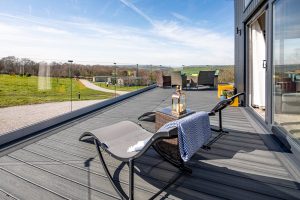
Solid and capped boards are favoured by leading composite decking brands like Trex as well as installers, as they offer the highest level of performance, protecting against colour fade, stains, scratches and other damage – even with minimal maintenance. The solid core offers the highest level of structural integrity and ‘capped’ refers to the addition of a protective outer shell, meaning that these types of boards should come with a manufacturer’s warranty of at least 25 years, or even 50 years, for residential decks and 10 years for commercial decks. Available with or without grooves on both sides to accommodate hidden fixings, not only do these boards guarantee structural integrity when installed correctly, but they also offer a sleek overall finish.
SOLID AND UNCAPPED BOARDS
Also available without or without grooves for fixings, solid and uncapped composite deck boards do provide some benefits – particularly in terms of structural performance and integrity due to their solid core.
However, these boards don’t feature the added protective outer layer, meaning that they’re more prone to colour fading and other signs of wear and tear. This affects the overall appearance of the deck in the medium-term, so when purchasing this type of board, it’s important to choose trusted brands with a manufacturer’s warranty to maximise customer satisfaction.
SCALLOPED BOARDS
Offered by some leading composite decking manufacturers including Trex, scalloped boards feature a solid core but with only one useable side. This means that – when the board is also capped – they provide structural integrity and fade resistance at a lower price point, making them a popular choice for those looking for a cost-effective composite decking solution.
Uncapped scalloped boards also provide product performance, but they are subject to earlier colour fade. It’s therefore important to purchase these from trusted brands that have undertaken performance testing and certification.
HOLLOWCORE BOARDS
Although they usually offer a cheaper solution that may be easier to install due to being lighter than solid core deck boards, specifiers should be cautious when purchasing boards with a hollow core.
These boards don’t offer the same level of strength as solid core boards, making them unsuitable for commercial decks that will see heavy footfall. However, when they’re also capped, hollowcore boards from trusted brands – with a manufacturer’s warranty – may offer a cost-effective solution for residential decks that are used by fewer people.
It’s important to avoid decks that have a hollow core and are uncapped. While the low price point may be tempting for both landscapers and customers, these boards are subject to structural failure and significant damage in terms of scratches, stains and colour fading. This short lifespan can incur the cost of replacing the deck in the short term, meaning the initial cost is in fact too good to be true.
Considering the cost-benefit of each type of composite decking board on a project-to-project basis, accounting for factors like budget and application, is key to choosing the right type of composite decking board for the job. It’s also important to always purchase boards from a trusted supplier with a comprehensive warranty for protection – and peace of mind.