UP THE GARDEN PATH
- Garden
FencingLandscapingNews
- 8th July 2026
- 0
Louise stumbles across some previously unknown weird yet wonderful specimens…
Here are a handful of plants that have caught my attention over the past few months. You’ll know if you’ve ever read any of my previous articles, that I don’t profess to be any kind of expert, but rather an enthusiastic amateur. I’ve been growing plants for more years than I care to remember, and I guess I have reached the stage where I think I’ve pretty much seen it all. How utterly ridiculous that is, because obviously that’s not the case, and here are four examples that have literally leapt up and said, you don’t know my name, do you?
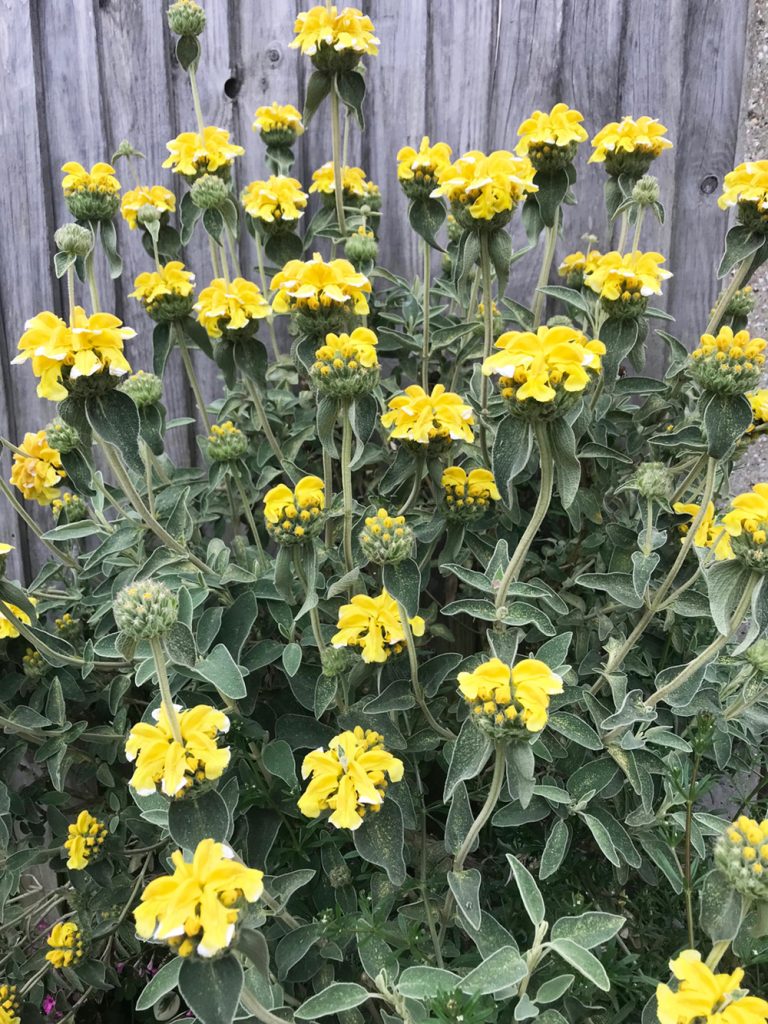
In the case of a couple of them I think I have seen them before, probably have been walking past them for years, but somehow they have not really registered. The first one Jerusalem Sage (Phlomis fruticosa) is an evergreen shrub with wrinkly, slightly hairy, grey-green leaves. Yes I know, it hardly sounds attractive, however it has the most startling, intricate yellow flowers that grow in whorls. The flowers start as strange bobbles on the upright stems. It’s tricky to describe so please have a look at the photo of Jerusalem Sage that I’ve taken. It’s fairly obvious it is a sage when you look at the leaves and that it originates in hot Mediterranean countries. The flowers last for ages, it’s very drought tolerant and it is a great ground cover plant.
The next strangely attractive one to pop up on my radar is Honeywort, or Cerinthe major ‘Purpurascens’. It is an ethereally pale grey, fleshy plant with contrasting purple drooping flowers that can last from late spring through to autumn. Apparently it is great for attracting bees and other pollinators, and is also drought tolerant, growing well in full sun. It is a very efficient self-seeder, so once you’ve got one, it will probably disappear in the winter and its seeds will thrive and grow the next spring.
Number three is Fritillaria imperialis. This one really did just stop me in my tracks. They were growing in someone’s front garden and I had to take a closer look (and try to take some photos). I was amazed by how odd they were, with their spiky upright, bright green leaves on the top, above a circle of rather lovely orange bell-shaped, dangly flowers, which contrasted with their almost black stems. There’s something a bit punk-like and anarchic going on, especially as they seem a bit ‘upside-down’ in appearance. The translation of its name is crown imperial fritillary, so there’s a reference to the circle of flowers or crown. However having done a bit of research, I have found out they are a member of the lily family, originating in Asia and have around 170 species to choose from. There are so many exciting ones, bright yellow, striking orange, deep purple and also amazingly chequerboard effect flowers, that are related to our native, wild plant, the snake’s head fritillary. I think I’m going to have to park this here and take a deeper dive for a later look at these, and try growing some of them myself.
Now, for the final choice, it really did rub in that there’s so much I don’t know. I was visiting someone’s house I don’t know well, they are a keen gardener, so I mentioned how lovely their garden was, it’s always a good way of finding a common interest.
“Have you seen my kowhai?”
Your what?
Within a minute I was outside and the mystery shrub was being presented to me, struggling to catch the name, I asked the owner to repeat it several times, but still came away none the wiser. It was a large shrub, with pairs of small glossy oval leaves. The flowers were exotic pendulous, golden-yellow and quite large, with tassels of stamens drooping from the flowers. I was given permission to take some snaps, sorry the results aren’t great, but hopefully good enough for you to see this is in fact an unusual creature indeed. My investigations revealed later that it is a kowhai, also known as New Zealand laburnum, or pelu tree. This particular one is Sophora molloyi ‘Dragon’s Gold’. So it’s native to the antipodes, which is why it’s so mysterious to me. As our climate is similar to NZ, this one seems to be growing well in the south east of England, and they should do well in semi-sheltered spots, until they are established.
I hope you’ve enjoyed some or all of these. It just goes to show it’s worth keeping your eyes open for new and surprising plants.