Not All Green Treatment Is the Same… So what are you actually getting with Platinum Incised 15?


REDUCE THE RISK OF SERVICE STRIKES


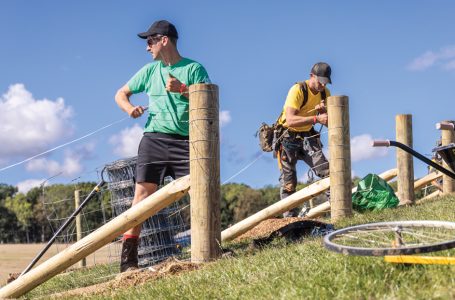
Whilst most of the construction industry has adopted robust working practices for reducing the risk of service strikes, it seems fencing installation is often lagging behind, with contractors often leaving their safety to chance.
For the last 30 years, my career as a utility surveyor has been the locating, surveying and mapping of subterranean utilities and infrastructure. With regard to fence installations, this generally involves locating buried utilities so that they can either be avoided at a local level, or providing more comprehensive information necessary in order to find the most suitable line or position for a proposed fence.
Fencing contractors’ risk assessment & method statements (RAMS) should address the risk posed by buried utilities. This safe system of working should be an integral part of every job, and should be implemented ahead of breaking ground. Along with other safe working practices it should include:
Properly planning the work
This may involve requesting service and utility records from the land or asset owners (gas, water, electricity, telecoms etc.) This service can be outsourced to online providers such as Cornerstone projects, Groundwise, Stats-Search etc. Additionally, make use of local knowledge and ask the client, land owner or others familiar with the site, if they are aware of any utilities in the vicinity.
Detecting, identifying and marking underground services For some residential, agricultural or low value projects, it may not be commercially viable to commission a specialist to carry out a pre-dig survey. That said, it puts the onus on the contractor to carry out essential mitigation and control measures in order to reduce the risk of a utility strike.
Following reference to service drawings You should walk and visually assess the site – this may help point towards the likely position of utilities detailed on record drawings, and also highlight the presence of utilities which may not be recorded. It is worth noting that services on privately owned land are less likely to be documented on drawings provided by utilities companies.
Things to look out for may include: utility poles, gas or water valves and hydrants, marker posts (especially at field / land boundaries) visible service trench scars or subsidence, inspection covers, service boxes, cabinets etc.
A CAT scan (cable avoidance tool scan) should be carried out over the area. Firstly, any known or suspected utilities should be targeted, either by ‘active’ signals induced onto the utility, or by focused ‘passive’ scanning (detecting naturally present signals that may be radiated by metallic pipes or cables).
Following the targeted search, a passive scan should be carried out over the entire area. Multiple transects should be taken both parallel and perpendicular to the proposed fence line. It may prove advantageous to have any existing fencing or temporary Heras type fencing removed prior to carrying out the scan, as signals radiated from above ground metallic fencing can mask subtle signals from services below.
The CAT scan should be undertaken by a suitably qualified and experienced person. Basic CATs can be bought or hired relatively cheaply. It will be necessary for a member of your team to take a training course for its correct usage.
Safe digging practices
Dug post holes or foundations should be excavated with caution. Tell-tale signs of buried services may include: pea gravel, sand, marker tape, tiles or disturbed ground. If any of these are encountered, either abandon the location or excavate further with extreme caution. If using machinery, a banksman should supervise the excavation to keep aneye out for any indication or warning sign of services.
For commercial, industrial or any projects where allowance can be afforded in the budget for a professional pre-dig survey, this is certainly the best option.
In addition to using survey grade CATs, along with a comprehensive suite of accessories, a professional surveyor should have other technologies and instrumentation available, such as ground penetrating radar (GPR) metal detection and magnetometry. This can increase the prospect of detecting both non-metallic services, and metallic services that may not be carrying or radiating sufficiently strong signals to be detected using a stand-alone CAT.
In addition to marking the position of detected services, a professional surveyor can accurately coordinate and map the position of detected services and produce a CAD drawing of results – for future reference or comparison with existing records.
It should, however, be noted that there are many variables with utilities, ground composition and site conditions, and that even the most experienced surveyor, using the best equipment available, may not be able to detect all of the utilities present.
With regard to locating utilities, the following basic guidelines apply: metallic services are generally easier to detect that non-metallic. A deeply laid service will likely prove harder to detect than the same service at a shallower depth. When using GPR, larger services may prove easier to detect than smaller ones (at the same depth).
Whichever route you choose, the onus is on the contractor to address the risk of service strikes. Damaging a utility can be both dangerous and costly, and the finger of blame may get pointed in all directions. You need to be able to demonstrate that you have addressed the risk and followed correct procedures.
Further guidance may be found within publications HSG47 and PAS128. For advice or possible assistance in Mid & West Wales I can be contacted at digby@rkgeomatics.co.uk