UP THE GARDEN PATH

Louise discovers some unexpected and unusual horticultural treasures
Whilst walking with some friends that had come to visit Canterbury, back in late September, I showed them Solly’s Orchard, one of the public gardens this lovely city has to offer. It was a good choice as the amount of colour and loveliness that we were able to feast our eyes on was incredibly pleasing. I took plenty of photos, especially of some of the more unusual specimens that my friends and I were very taken with, and whilst doing this I decided that this would make quite a nice selection of plants for me to write about and show you, possibly some that you may not have seen before.
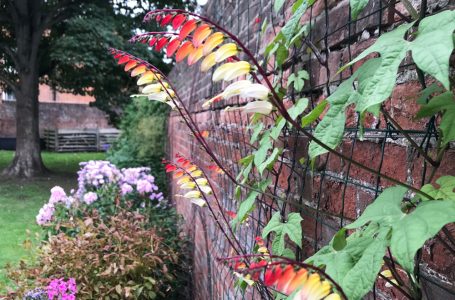
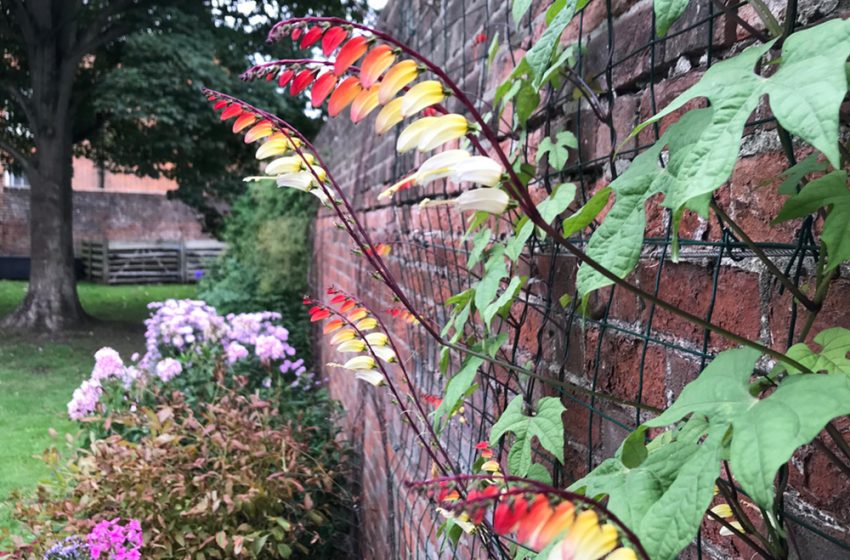
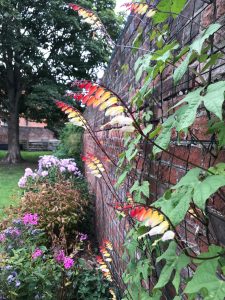
I’ll start with this eye catching South American beauty, the Spanish Flag or firecracker vine. This perennial climber’s proper name is Ipomoea lobata and it’s a member of the Convolvulaceae family. It has a quite startling appearance, this one is very happily growing up a sheltered wall, which suits its growing habit very well, it has dark thin stems with tri-lobed leaves and the abundant flowers form in one-sided sprays, that are a mix of fiery red, orange and yellow, that almost look like flames streaking up the wall. They are fast growing and can shoot up to 5m tall. This one had reached the top of the wall in places and was going over it. They will flower for several months through the summer and don’t like the temperature to go lower than 10 degrees, so a very sheltered spot is required to help them get through the winter, or you could pot it up and bring it inside.
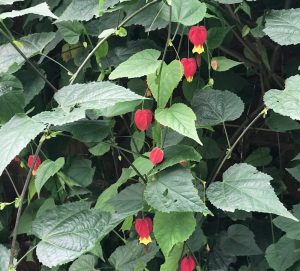
Growing close by and enjoying another stretch of the sheltering wall was another Latin American lovely, Abutilon megapotamicum, that has been one of my favourites for many years. It’s not surprising to find it enjoying the same sort of space in the garden as its requirements are almost identical to the firecracker vine we’ve just been looking at, so most of the winter care suggestions apply here as well, along with an additional suggestion of taking some cuttings just in case to ensure you have Abutilon for the next year. This beautiful plant has a less dramatic appearance than the Firecracker with pendulous, bell-like flowers, red at the top with a yellow flare at the bottom, they are delicate, quite magical and still very much worthy of a mention.
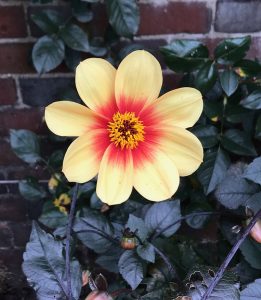
My next choice may not seem quite as exotic or unusual as it’s only a Dahlia, I’m sure many of you are aware of them, as they’re quite commonplace in a lot of domestic gardens, but as Dahlias go this one called ‘Moonfire’, in my opinion, is something special. Just look at the deep bronze-purple, almost black coloured glossy foliage, which acts as a perfect contrast to the superb bright yellow single flowers, with orange-red radiating centres. I think it’s absolutely stunning. The abundant flowers should last from July to September with the plant reaching over half a metre in height. As with all Dahlias they need protection from frosts, so the tubers need to be brought in and stored over the winter.
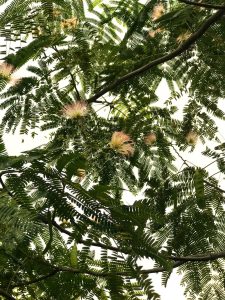
My final offering is a bit of a wild card, and strictly speaking it’s not actually a plant, it’s a tree! But as I’m showing you some more unusual specimens I hope you’ll give me some leeway on this. This tree was in the same garden, I was initially attracted to its foliage, thinking it was reminiscent of Mimosa, or Acacia with its soft fern-like foliage. Then I spotted the fluffy pink flowers amongst the leaves. I’ve tried to get a good photo to show you, which was tricky because it’s looking upwards, so it’s a bit like a silhouette as it is back-lit. However this does show the lovely ferny foliage well and the flowers are visible. This is a Persian Silk Tree, also known as Albizia julibrissin Rosea. Sure enough, my research says it is a cold hardy Mimosa, I had no idea these trees grow happily here in sheltered spots in the south and will produce the gorgeous feathery blooms from June to late September. How lovely is that?