THE POLYMER ADVANTAGE WHY MODERN GATE HARDWARE IS REDEFINING PERFORMANCE


UP THE GARDEN PATH


Louise Tomlin takes a look at the fascinating and fabulous family of plants known as Euphorbias
I was walking with someone recently and we passed through a garden that had a mass of Euphorbia wulfenii growing on a bank that sloped upwards above us, which gave the impression the huge plants were towering over us in a rather sinister fashion. My friend jokingly said that they were almost scary and looked a bit like aliens! I had to agree, there’s something almost other worldly going on with the euphorbia family, especially the bigger types like wulfenii, with their blue-grey foliage and large acid green flower heads that could almost be made up of lots of eyes, there’s more than a touch of the ‘triffids’ going on, as if they’ve escaped from a John Wyndham sci-fi novel. They certainly don’t conform to the archetypal picture book idea of pretty flowers with coloured petals on a green stem, but I find them attractive and kind of irresistible with their odd shaped flowers, if that’s what they are, as it’s difficult to work out what are petals and what are leaves on many of them.
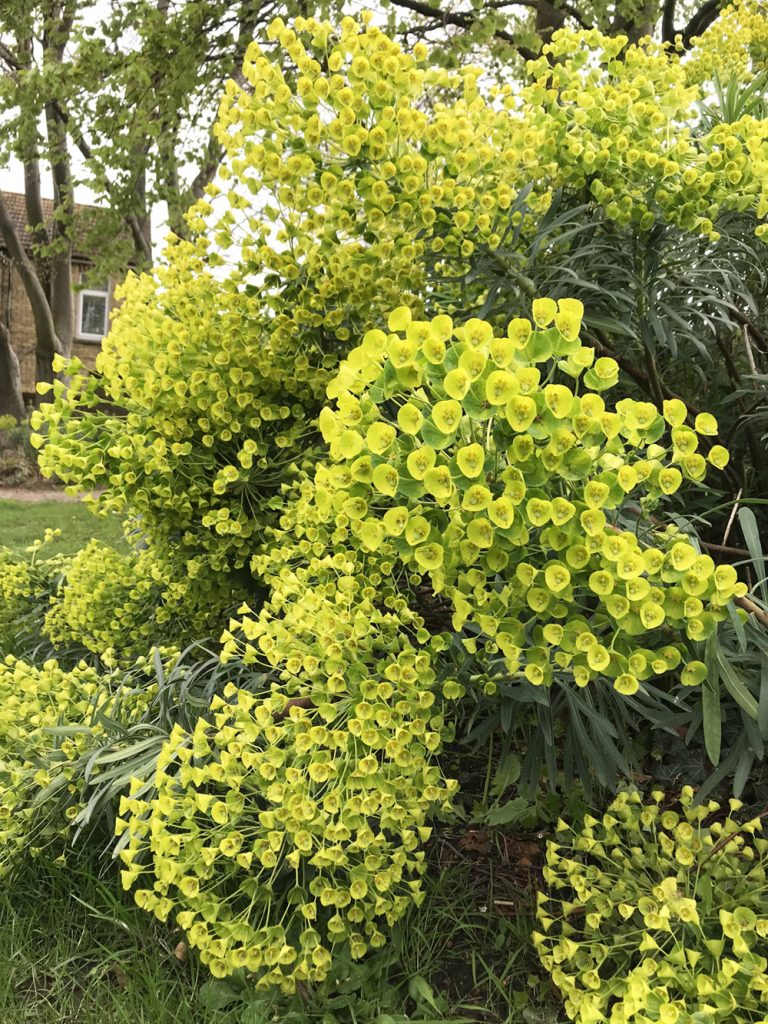
Along with the strange forms and shapes, I think the key to their attraction for me could lie in their colours, they range from what I’d like to call the vibrant ‘funky’ acid-yellow-lime-green-orange high notes, through to metallic grey-silvery-blue-green, with some strange burgundy-bronze bass tones thrown in, not to mention some quite exotic variegated versions as well.
Maybe that explains their fascination for me, they create incredible combinations of colour, in the main pic look at the way the euphorbias behind are a perfect foil for the orange tulips, which spark off them in a superb colour clash. It’s as if they were made to be together.
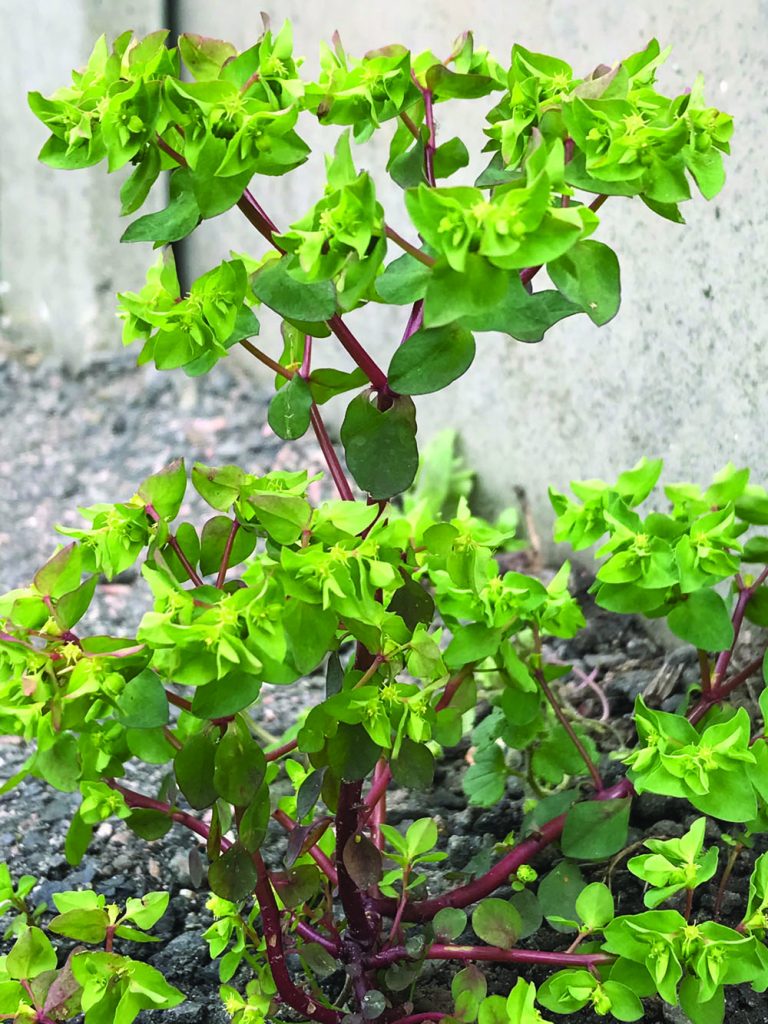
Wood Spurge
The euphorbia genus is a large, diverse group of plants, which mainly flower in spring and summer. They are generally happy in any situation in the garden, and most are hardy. They vary in size from very tiny plants to fairly hefty specimens, so when you are looking to buy some be very careful to read the label and take note of the size they are expected to attain (otherwise you might end up with your own alien invasion!). The little one in the photo is Euphorbia amygdaloides, you will probably be familiar with it, it’s the wild version and pops up as a weed in borders, pathways and also in woods. Known as wood spurge, spurge is the common name for the Euphorbia family. The origin is derived from old French ‘espurge’ which means ‘to purge’ as the sap was used as a laxative. In fact all of the family comes with a health warning to avoid the white sap that oozes out as soon as the plant is cut, it’s toxic and great care should be taken to avoid contact with skin and especially the eyes.
Having said these beauties vary in size, I was surprised to find out that plants like the wulfenni, I’ve already mentioned and are one of the most popular larger versions of Euphorbia growing to about 1.2m tall, are dwarfed by the big boys of the family like ampliphylla, which are tree size, growing up to around 30m, however we’re not likely to spot these here in the UK as they’re native to Africa. Along with their exciting and varied colours, many Euphorbias are great architectural plants that add stature, shape and form to gardens and can be very useful backdrops in borders, with their evergreen leaves.
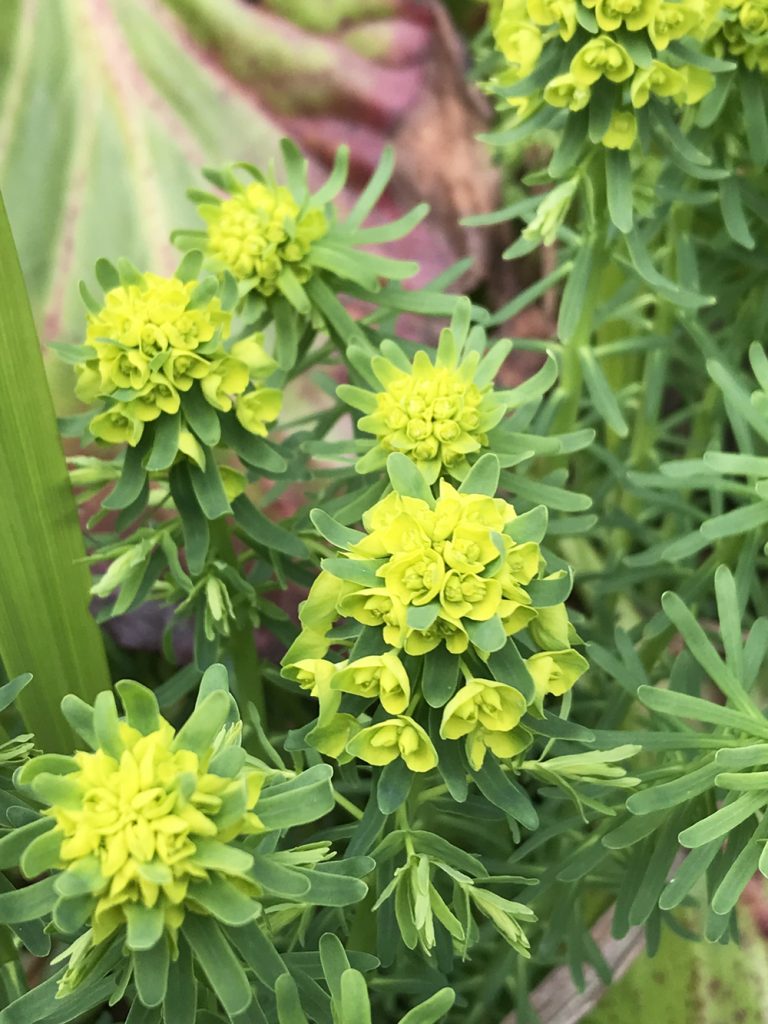
Another one that I’ve singled out to mention is E epithymoides, which is medium sized – approx. 0.5m, it has a clump forming habit and is also known as cushion spurge, so it’s useful if you fancied some gentle mounds. I’ve shown it in close up in the photo, I like the slightly blue oblong leaves and the way they contrast with the bright, delicate lime flowers. Once again the family resemblance is there, but it’s quite possibly a different kind of maybe second-cousin?
I hope I’ve managed to whet your appetite for this unusual genus of plants? There are many more exciting examples of them out there online if you care to look for something different and a bit more out of left field for your garden, enjoy.