How Timber Boundaries Weather the Years: Treatment, Material and Maintenance


HOME-GROWN SPRUCE AND THE PUSH FOR UC4f

How Modern Incising and Kiln Technology Are Reshaping the British Fencing Supply Chain
For decades, Sitka spruce has formed the backbone of the British sawmill industry—readily available, fast-growing, cost-effective and sustainable. Most home-grown fencing stakes, posts and other sections originate from this species, and yet, despite its ubiquity, spruce has historically struggled to gain widespread acceptance in one of the most demanding segments of the market: ground-contact Use Class 4 (UC4) products. This is not because spruce lacks structural integrity or environmental credentials, but because the wood itself presents a challenge when it comes to preservative treatability.
Spruce is a refractory species, meaning its heartwood is naturally impermeable to liquids under pressure. In the world of timber treatment, that impermeability matters. Treatment standards such as BS 8417 do not concern themselves with species on paper; they concern themselves with penetration and retention of the preservative within the zone where decay risk exists. For UC4, that zone is the portion of timber within or very near ground contact, where moisture, oxygen and fungal activity converge to form ideal conditions for biological degradation.
Historically, the British solution has been to import naturally permeable species—notably Scots pine or various European and Baltic pines—which, when pressure-treated, readily absorb preservative deep into their sapwood and heartwood. But as costs rise, carbon footprints gain scrutiny, and supply chains fluctuate, the timber industry has begun to ask a more fundamental question: can we produce reliable UC4 fencing components from our own plantations? And if so, how?
Incising Enters a New Phase
Surface incising is not a new idea. In North America, it has been used for decades in structural lumber production, particularly for refractory species such as Douglas fir. The principle is simple: a grid of tiny, controlled slits are cut into the surface of the timber, allowing preservative fluid to bypass natural blockages and penetrate into the interior zones that matter for durability.
What is new in the UK is the arrival of purpose-built industrial incising machinery designed specifically for fencing production—as opposed to retrofitted planer heads, experimental prototypes or slow manual systems.
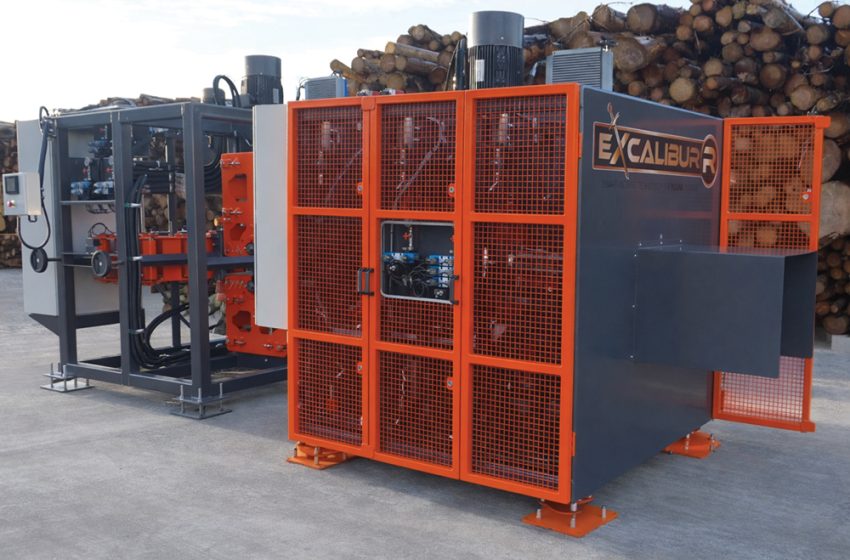
This is where Timber Treatment Solutions enter the picture. Over the past ten years, the company has introduced and evolved a family of Excalibur incising machines engineered to serve the sawmilling and treatment sectors that dominate fencing supply across the British Isles.
Joe Watson, Director at TTS, explains the shift with characteristic pragmatism. “Incising as a principle has been around for a long time, so we’re not pretending to have discovered anything,” he says. “What’s genuinely new is the fact that this technology is now available in a way that integrates easily into UK sawmills, treats both round and sawn sections, and supports BS 8417 compliance for UC4. That’s what our Excalibur range is about.”
The Excalibur line includes two core platforms: the Excalibur R-Series for round stakes and posts (with two models covering diameters from around Ø63mm up to Ø275mm), and the Excalibur Pro for sawn square or rectangular sections such as sleepers, structural profiles and landscaping timbers. Importantly, these machines are designed for industrial uptime, safe handling, and predictable workflows—removing many of the barriers that previously made incising seem like a niche curiosity rather than a production asset.
“Spruce posts aren’t new, and neither is incising,” notes Arvid Nielsen, who represents TTS across the UK & Ireland and plays a key technical role in the company’s incising deployments. “What’s different today is that sawmills finally have access to the same kind of intelligent machinery that can be seen in all other areas of the sawmill. With the right drying, conditioning and incising processes, spruce makes a perfectly viable UC4 product.”
Arvid has witnessed the approach first-hand in some UK operations already, where machining, incising, drying and high-pressure treatment form a continuous industrial chain. In that context, incising is not a gimmick—it is a process enabler.
But even the best incising system cannot overcome one fundamental truth about treatment: you cannot impregnate water with preservative. If a timber component is saturated internally, the fluid pumped into it under pressure will simply be forced back out. The result is poor penetration, poor retention, and ultimately poor durability.
This brings us to the other half of the UC4 conversation—kilns.
Drying, Conditioning & UC4: The Kiln Side of the Story
In many British mills, kiln capacity has historically been deployed for structural timber, joinery timber or export product. Fencing stock, by contrast, was often treated green, partly because standards allowed it and partly because in a softwood, low-margin environment, anything seen as an extra processing step was viewed with suspicion.
This shift to kiln drying more of these types of products is gaining traction in the UK—and TTS is playing a central role as the UK & Ireland representative for Nardi / Incomac (part of the Italian Drying Group), a leading European manufacturer of industrial kilns designed for sawmills, fencing producers and treatment operations.
“Drying spruce for UC4 isn’t about trying to reach joinery moisture levels,” Arvid explains. “It’s about stabilising the timber, relieving internal moisture, and ensuring the treatment actually goes where it needs to. IDG’s control philosophy is built around that idea—practical, predictable industrial drying that makes pressure treatment work.”
IDG’s systems are not generic drying chambers; they are tailored to industrial outcomes. Progressive kilns handle continuous throughput for sawmills, while flexible batch kilns support mixed stock—machined rounds, peeled posts, sawn profiles and composite packs. The controllers monitor humidity, temperature, airflow and moisture content to produce treatment-ready timber without unnecessary degrade.
For Joe Watson, this dovetails perfectly with the company’s incising vision. “You can incise spruce all day, but if the moisture content isn’t right you’re still pushing out preservative during treatment. IDG gives us the conditioning element that makes the whole UC4 workflow reliable.”
The commercial implications are considerable. By drying and incising before treatment, sawmills can produce UC4 spruce posts that match the performance expectations of farmers, merchants, fencing contractors and specifiers, while reducing dependence on imported pine. In an era where carbon accounting, local sourcing and supply chain resilience are no longer fringe topics, this matters.
There are also sustainability benefits that resonate beyond the mill gate. Domestic drying reduces haulage emissions, supports rural forestry economies, and increases the utilisation of British plantations—many of which are now entering maturity. Every kilometre shaved off the journey of a post is a kilometre that doesn’t need to be offset or justified.
What This Means for the Future of the Fencing Market
The transformation underway is not speculative. It is observable in the equipment being ordered, the market conversations taking place, and the standards that clients are beginning to demand. As BS 8417 and its accompanying guidance documents continue to influence quality expectations, and as infrastructure and agricultural clients become more aware of performance metrics, the British spruce value chain is aligning around a new reality: durability is achieved by process, not by species alone.
As Joe puts it: “Most British sawmills have a steady supply of spruce. If you can take that resource, machine, incise, dry and then treat it properly, you’re adding value at every stage and keeping that value at home. For agricultural fencing in particular, farmers are increasingly looking at sustainability and long-term performance—and they’re starting to ask where their posts come from.”
If this trend continues—and all indicators suggest that it will—the UK may soon see the day when UC4 spruce is no longer viewed as a compromise product or a stopgap, but as a mainstream, reliable, home-grown solution. With the right machinery on the incising line and the right kilns in the yard, the technical barriers are falling. The market dynamics are beginning to follow.
And judging by the early response to TTS’s expanding equipment portfolio, Spruce’s moment in the UC4 spotlight has only just begun.
www.timberpreservationtechnologies.com