MOVERS & SHAKERS


JOCK BRYCE
It might be a well-worn cliché but it’s true to describe Jock Bryce as a big hitter within the fencing industry!
Born in Edinburgh in 1946, Jock’s entrepreneurial spirit and hard-hitting innovations have played a very real part in transforming the lives of fencing contractors across the UK and much further afield.
Jock takes up the story: “I farmed with my late father. He suffered acute depression and on specialist advice I was told if we did not leave the farm the depression could kill him. There were no options so we had to vacate the tenancy and leave in May 1968 when I was 22 years old and driving away from the farm and my home that night was a very traumatic moment. I was walking into the unknown and had just £25 in my pocket.
“This was a terrible blow as hill farming was all I knew and a bitter pill to swallow but, thankfully, my father recovered. During the summer of 1968 I spent these months reclaiming hill ground at Elmscleugh farm high up in the Lammermuirs.
That autumn I took up the position of shepherd at Hetton Hall Farm with 1200 Grey Face ewes. I was earning £9 a week!
“One Sunday there was a knock on the door by a Mr Ken Smith. He had tracked me down to offer me the job of looking after his 550 acre mixed farming operation which included breeding sheep, suckler cows, cereals and potatoes on a day to day basis. I accepted the job at £13 a week.
“After three years I had a yearning to get back to the hills and applied for a job as farm manager on a 1360 acre hill farm at East Brackland near Callander in west Perthshire tenanted by the Farmers Weekly. Out of 61 applicants and after 4 interviews I was offered the post based on my proposals going forward. I accepted the offer.
“Unfortunately, due to the success achieved, this took the farm into conflict with one of the Farmers Weekly’s six other farms which was another similar set up in Northumberland. The tenancy was terminated and I was offered two other managerial jobs on a proposed dairy farm or beef enterprise finishing on maize in SW Scotland, neither of which appealed to me.
“I decided to head back south to my native countryside in the Scottish Borders to start up a new business on my own. I was given the chance to buy anything on the farm so I sold my one year old Escort Mexico to fund the David Brown 990 Implematic, welder and various other workshop tools. I put everything on to a homemade 27ft bale trailer and headed south to Kelso. It took me 8 hours 10 minutes nonstop! Driving through Edinburgh with no lights on the bale trailer, only hand signals and a chalked on number plate today may have created interest from the boys in blue !”
“The new venture was called “Relief Farm Services” and I was offering lambings, shearing, Bryce permanent electric fencing and bale handling. I manufactured a flat eight bale grab to cart customers’ hay bales from field to barn with no physical handling. I also did welding and offered the supply of hydraulic components.
“My own brand of permanent electric fencing, which included three Bryce patented components, proved to be very popular. I started off doing everything by hand and then to help speed things up, purchased a handheld engine driven auger. This lasted one day! It was ok in good ground and a step up from hand digging but no good at all in hill country.
“I soon gathered the funds to purchase a tractor mounted auger with a special cutting head for severe conditions. This was a good tool but it still involved a lot of hard work backfilling and compacting soil when setting in straining posts.
“Too much time was being lost so I arranged a demo of a Canadian built post driver and bought it there and then. Two years later I bought another hardly used one plus another tractor so that I then had two outfits to let me work with two customers, keeping them both happy and not losing out on business.
“These post drivers were good at the time but I needed to get posts into the ground faster so I started making my own designs with bigger hammers. Basically, I looked around and could not find the Post Driver that fitted my design criteria, so I decided to build my own. The evolution of this machinery was relentless and I was always in pursuit of perfection.
“All my work was in hill country so these post drivers I developed were trailed machines, which allowed me to transport all tools and materials. They had powered axles which on the back of a 4wd tractor fitted with ground drive gave me 6wd and allowed me to go anywhere, as long as my nerve would hold.
“What I had developed was a groundbreaking design and I started thinking that a mounted version would be a big hit in the marketplace. This rapid development of mechanised fencing helped me erect over a million metres of permanent electric, a lot of which was single hot scare (guard) wire on dry stone walls.
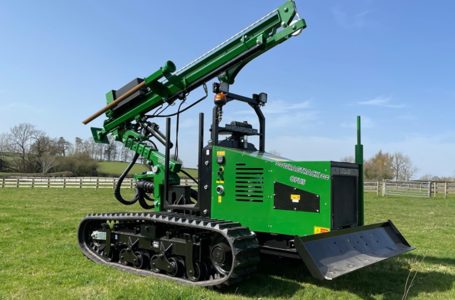
“In 1997 I introduced my first machine, a prototype and promptly sold it within a week. Three more were made and all were sold before completion. On and on it went and the rest is history! The Bryce Suma was born!
“Having started with nothing, I was driven by the fear of failure and was very conscious that if I didn’t protect my ideas, competitors could possibly copy and capitalise on what was my IP. To this end, I spent a lot on 13 patents to give me peace of mind.
“When a person who has come up with the design, spending long hours bringing it to a commercial reality and then others try and take credit I consider it to be completely unfair and unethical.
“Prior to starting manufacturing post drivers I ran a suckler cow herd as well as a big silage and straw operation dealing with 32,000 bales/annum which had to be ditched when the post driver business took off. The cows were sold and the cattle shed converted into a fabrication business.
“There was also the groundworks business that featured strongly in life’s path that my son Stuart oversees.
“With all the time and effort that went into developing the post drivers it was a very proud moment when we won 3 Gold Medals for Innovation and Excellence in the same year at 3 premier UK Agricultural Shows, something that no other UK or International Company had achieved since the inauguration of these shows in the late 1800’s!
“In a way I paid a heavy price for this relentless drive and never slowing down when I was diagnosed with chronic fatigue or ME. I would not wish that on anybody and it took me many years of special diet and therapy to get back to my old self.
“I’ve never believed in hanging around and don’t suffer fools gladly. Seize the moment is my mantra and I’ve always enjoyed engaging with people and trying to cut a deal whether it’s for a machine, timber or even a pair of trousers!
“I also believe that honesty and patience brings its own rewards. Always go the extra mile and always honour your word,” added Jock whose company employs 12 people from its base near Kelso and currently offers two tracked machines as well as eight tractor mounted machines.
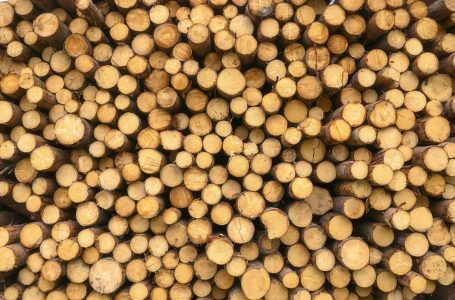
“The industry has changed beyond all recognition. From hand work and hard graft to sophisticated tractor mounted post drivers and radio controlled tracked versions, from Scots Pine creosoted timber and European Larch that lasted 40-50 years to incised Spruce with water based treatment offered with 15-20 year guarantees.
“Galvanised steel variants have hit the market to help overcome the rapid decay of homegrown timber that’s been poorly treated.
“In my day poorly treated timber was unheard of. It was all air dried and never treated until it was dried out properly which could take up to 9-12 months.
“Going forward from where we are is a headscratcher because we always have strong demand with the products we produce as customers purchase our machines for their performance, design and durability. There is a massive amount of electronic wizardry in machines and motors today and we hear of the many woes owners endure with electrical failures of some kind. What I hear in the motor, truck and Agri industry are issues that can only be resolved with a laptop. Great stuff when it works but not if you are broken down on the roadside or hill top.
“I am old school and know from hard won experience that if you are out in the wilds you require equipment that is as near bombproof as possible. I always worked on my own and did not want to lose daily output with malfunctions of ANY kind.
“If it aint broke don’t try and fix it comes to mind and if demand is there for what we offer, then build on that. But we do have an open mind and are always thinking and listening.
“Jennifer and I are in the back seat now after 50 years of many long hours and years of ups and downs. Without her I know for sure we would not be where we are today.
“I’ve now handed the baton over to two of my sons Andrew and Stuart. They both have different strengths and work well with each other. Andrew’s wife Louise is heavily involved in the accounts with Stuart’s wife Kerry also assisting in that department.
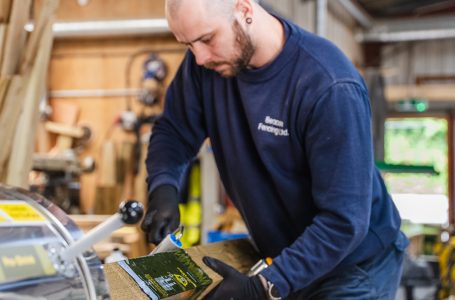
“My third son Ian has his own business doing top end carpentry
work and is in strong demand. All are blessed with “attention to detail” in their DNA.
“Grandsons Cameron and Angus are in the fabrication and prep part of the manufacturing side and I’m always there on call to pass on any wisdom or experience to all, whether it’s in our business or to customers.
“My job is my hobby and, if you enjoy what you do, you never work a day in your life.
“Saying that, I do have a number of interests including a collection of four modern classic cars and seven vintage tractors as well as enjoying cycling, stick dressing, writing and photography!”
With Jock’s machines used in 23 countries around the world, it’s fair to say that this ‘big hitter’ has spread that sense of enjoyment and played his part in making this industry what it is today.