UP THE GARDEN PATH


Louise Tomlin muses on the importance of keeping an open mind and realising there can be more than one right answer out there.
Have you ever had a moment when something you know, or think you know turns out to be wrong? It can be unsettling when it’s a long held belief or nugget of knowledge that you had banked as a ‘fact’ for many years and then suddenly it is revealed as bogus. This happened to me regarding a certain plant that I was absolutely certain I had known for many years. Okay, I know it’s hardly the end of the world type stuff, but I’m a bit of a stickler for getting things right, as a writer and a gardener I pride myself in digging deep, pardon the pun, and doing my best to ensure I know what I’m talking about. Maybe this is a wake up call, telling me that I shouldn’t become set in my ways, as I get older?
I guess when I reveal what the error was you might say, easy mistake that anyone could make, don’t beat yourself up. We’ll see, as I said it’s not like it’s going to alter the course of history or anything.
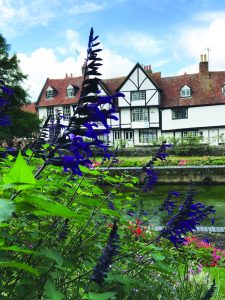
So picture the scene, I’m walking with a gardening friend admiring some very lovely gardens, brimming with beautiful plants and flowers. There’s a border with a collection of tall plants, up to four feet high, they have upright stems with delicate blue flowers dotted all the way up to the top of the stems. There are others that appear to be variations of this plant, some have violet flowers, others red, all really quite tall. I know I’ve seen them or something like them before, but I’ve never really logged onto them before. I ask my friend if she knows their name, and Lobelia is her response. Bombshell!
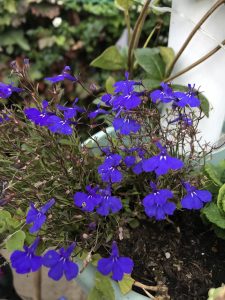
I don’t like to contradict her, but no, I don’t think so. I know Lobelias, I’ve seen them for years, ever since I was a kid, my mum always had them in hanging baskets, tiny blue flowering plants, quite an old school plant, popular with gardeners of a certain era.
the two top ones stick up, while the
other three lower ones fan out
A vigorous discussion followed, that remained polite but with both parties convinced they were right. We didn’t fall out about it, and as it turns out we were both right in our own way. They are both Lobelias, or from that genus or family of plants. I think the difference in scale is possibly what threw us, she’d never seen the little ones that I was certain of, she grew up in another country and likewise, I wasn’t previously aware of these gigantic cousins.
It was time for some investigation, the good old Internet allowed us both to save face and educate ourselves about Lobelias. Apparently, there are quite a lot of them out there in the world, large and small, annual, perennial and even some shrubs. They can be both hardy and tender and come from a variety of habitats, and there is a wide range of colours.
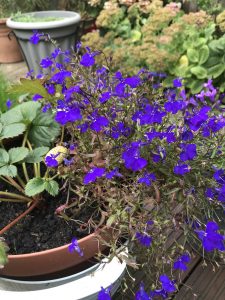
(for scale shown here next to
strawberry plant)
A particular sentence in their description made me smile; many species appear totally dissimilar from each other. Well, that explains a lot. What they do have in common is alternate leaves and two-lipped tubular flowers, each with five lobes, the two top ones stick up, while the other three lower ones fan out below. I had previously noticed the lower petals were ‘lobe-shaped, and here’s another misconception I had stuck in my brain, I thought the lobes were why they were called Lobelia. When will I ever learn? Apparently, they are named after the Flemish Botanist, Matthias de Lobel.
I am happy to say I’m now a big fan of this genus of plants, especially the tall varieties, which are also commonly known as Cardinal flowers, I’ve put a couple of photos of them here, the deep blue is Lobelia ‘Vedrariensis’, the other is Lobelia ‘Hadspen Purple’. I’ve been surprised at how many varieties I have found online, including a very lovely bright red one with almost black foliage called Lobelia Cardinalis ‘Queen Victoria’ (sorry, I have no photo of this one, if you look online you’re in for a treat).
As I said earlier, it’s not earth-shattering, but it does reinforce the thought that just because we think we know something it pays to keep an open mind and to check our facts, that way we can learn and grow, not just our plants but our knowledge too.