UP THE GARDEN PATH


Louise takes a look at the colourful hardy Hibiscus to give your garden a tropical vibe.
Recently I have found that the beautiful Hibiscus plant has popped up on my radar a couple of times. I was asked to write an article about an award-winning local gin company for another magazine. Not the worst job in the world, I must admit, combining visiting the wonderful seaside town of Whitstable on a hot summer day and having to sample very lovely craft gins. I was particularly interested to find that along with their Seabuckthorn and Samphire flavoured gin, they also had a second very lovely soft pink, Kentish cherry and Hibiscus flavoured gin that definitely grabbed my attention. I must say both flavours are outstanding, but the Hibiscus pinged with me because throughout the summer months, I’d been taking lots of photos of the type of Hibiscus that grows here in the UK, rather than the tropical ones I was fascinated to see several years ago when visiting Indonesia. So that was enough to spur me on to delve into them a bit further.
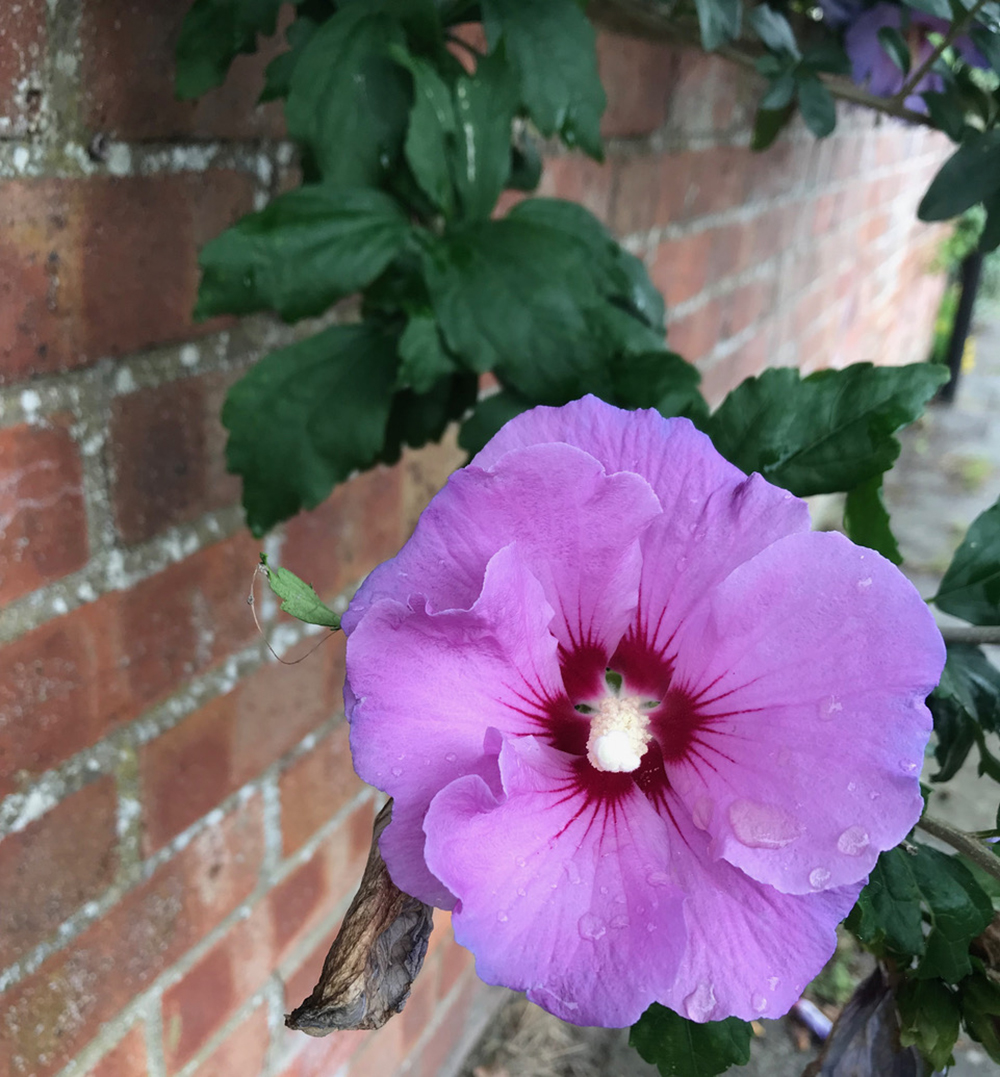
Our hardy Hibiscus, shown in a few photos just in case you’re not familiar with it, is a shrub-like perennial that has dark glossy leaves, with a welter of spectacular flowers, that come in many colour combinations, some with darker centres, that surround and accentuate the central column of stamens, giving them an exotic appearance. They are from the mallow family (Malvaceae) so there’s more than a passing resemblance to flowers you may be aware of like hollyhocks and lavatera.
I think they make an ideal shrub for mixed borders, with certain types growing up to 1.5m to 2.4m, delivering a lot of bang for your buck with a long and abundant flowering period from early summer through to the first frosts of autumn. They can also be grown in containers and are low maintenance, preferring sheltered sunny spots, with well-mulched soil, to help maintain moisture. Be prepared to give them a good long drink if rain has been sparse, and treat with a liquid feed like tomato food a couple of times a month.
In my opinion they are very nearly as beautiful as their stunning cousins that are native to China, India and East Asia. Just look closely at the flowers, the chiffon-like petals are delicately pleated, some with dramatic contrasting patterns that spike outwards from the centre, great for adding a touch of the tropics to the summer show in your garden.
I’ve tried to identify and name some of the Hibiscus that I photographed and have included here. The showiest one is Hibiscus Paraplu Pink Ink. The stunning pale creamy petals tinged with pink have the darker striking ink-like pattern radiating from their centres. It’s an eye-catching specimen, up close but also when seen from a distance with masses of flowers on show.
Hibiscus Paraplu Violet, cool mauve-blue flowers with deep red centre markings that contrast beautifully with its pale stamen column, drawing your attention in for a closer look.
The light pink, Hibiscus Syriacus Pink Giant, has stunning delicate blooms. You can see from this longer shot I took of the bush how plentiful the flowers are. Interestingly, the flowers only last for a day or so before they wither and drop, but there’re always masses of buds about to burst into bloom to replace them.
With all this colourful action, I really need to show you the other end of the spectrum with these gorgeous pure white ones: Hibiscus Syriacus ‘William R Smith’. I’ve long been a fan of a white flower and these definitely do it for me, with their snow-white crepe-like petals, with a suggestion of cream at the centre and dramatically contrasting very dark foliage.
I hope I’ve opened your eyes to the wonderful Hibiscus plant with just a taste of the varieties you could have in your garden. Apologies for not showing all the different colour versions that are available – if you want to see more there’s a lot to see online. Enjoy!