UP THE GARDEN PATH


Do you like the the big bearded variety or something more sedate? Louise Tomlin takes a look at the different types of the popular Iris.
Searching through my photo library recently I came across some lovely images I’d taken last summer whilst visiting Walmer Castle Gardens in Kent, which is something of a hidden gem, I can recommend visiting to fellow garden lovers who enjoy an inspiring wander around a picturesque and historic setting.
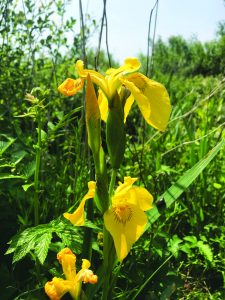
There were several photos of different Irises, I remember at the time trying to capture their delicate elegance, which I think I partially achieved. This made me reflect on these popular, colourful and showy plants, and how little I really knew about them, so I decided to do a bit of research to find out more.
And once again I’ve stumbled into a subject that I thought might be relatively simple that has turned into a rather confusing journey that challenged my powers of comprehension. Perhaps it’s the language used on some horticultural sites that boggle my mind, possibly it’s that I continually cross-reference facts, or maybe I’m just a bit dim. However I think got there in the end and I’ve attempted to unravel the key bits into a simplified version, fingers crossed.
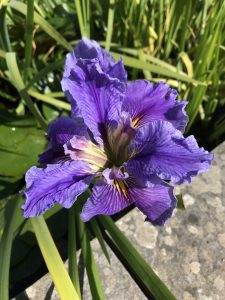
But first the obvious stuff, iris is the common name for all iris species, although they can also be referred to colloquially as flags. The name is derived from the Greek Goddess of rainbows and many varieties’ flowers are dazzlingly colourful with deep blues, purples and yellows. Typically the flowers are fan shaped, six lobed and symmetrical with three large petals alternating with three smaller, sometimes erect petals. Though this does depend on the type, and with over three hundred recognised species and a bewildering amount of subgenera to choose from, it can be tricky.
Starting at the beginning there are two main iris types; ‘bulbous’ growing from a bulb or perennial growing from a ‘rhizome’, a fleshy root. The bulb iris can be sorted in to two main types depending on the time they bloom. If they are early flowering, when snowdrops appear, they are iris reticulata. You may have seen these miniature ones, a similar height to snowdrops that give a welcome splash of purple and blue so early in the year.
The other bulb iris are Dutch, English or Spanish types, they bloom in mid summer, in a wonderful variety of colours and flower shapes, and are definitely not tiny with some reaching up to a metre tall. They prefer well-drained soil in sun or partial shade, advice that goes for the majority of irises. Another factor is shelter from harsh winds as they can be damaged easily due to their height.
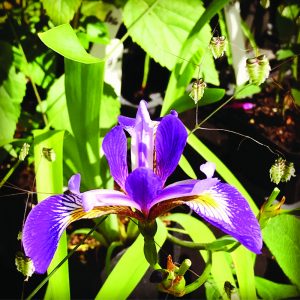
The perennial irises grown from rhizomes, are usually summer flowering, and can also be sorted into different types: German, Japanese, Louisiana, Siberian and the Yellow Flag. However, these can also be divided into groups with descriptive names like ‘bearded’. They are undoubtedly the most colourful and extravagant type, they have three upright petals named standards and three descending petals called falls. In the centre of each ‘fluorescent’ or flower is a furry band reminiscent of a caterpillar, which is the ‘beard’. Bearded ones, are also known as German.
There is another group in the perennial type with the descriptive name ‘beardless’. Predictably they don’t have the furry centre bit and they are the Japanese, Siberian and Louisiana varieties, this is their main identifier as their flowers can differ enormously in size, shape, colour and frilliness.
As usual I have only scratched the surface of all the information available about these fascinating and iridescent plants in the attempt to give you a taster hoping to prick your interest. There’s a lot to love about them, although personally I have to admit some of the big beardy ones are a bit too over fussy for my taste being a less is more girl. I tend to prefer the quiet and simple beauty of Iris Alaska with its sublime whiteness with just that delicate kiss of yellow.