Up the Garden Path

Louise finds yet more drought tolerant, spiky plants…
Welcome back, to what is hopefully an England that is once more a ‘green and pleasant land’. What an amazing summer we’ve had, the prolonged extreme heat and drought experienced in many parts is taking some recovering from. I’m sure it presented new challenges of all sorts, not just to gardeners, but all sectors of industry, like farmers, fencers, landscapers and all.
These conditions are likely to be repeated in future, so I guess we’d better all start making adjustments and learn to adapt accordingly. I know this may be easier for some, than for others. Gardeners, for instance will be looking at more drought and heat tolerant plants.
This is a drum I’ve been banging on for a while, especially with some of the drought tolerant spiky plants I’ve featured previously like Phormiums, Yuccas, Agave and Cordylines.
So here are more unusual spiky plants, which go hand in hand with previous ones that I’ve mentioned. I must admit to being kind of obsessed with these kinds of plants, I hope I’m not being too repetitive.
I know I waxed lyrical about cardoons and how much I adore them, these are the giant artichoke thistles, featured in the last issue. So here are another couple of thistle-like superstars I must tell you about.
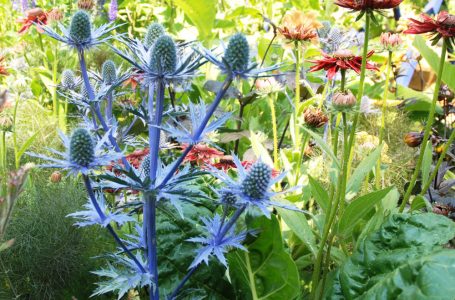
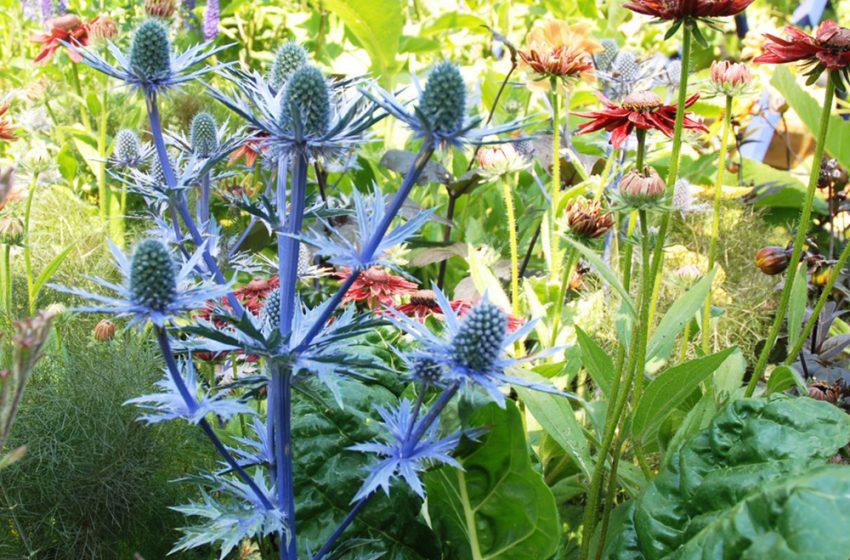
I’m starting with Eryngium, or Sea Holly, which are so unusual they blew my mind when I first saw them growing on a Greek island a few years ago. They tick a lot of boxes for me; the rounded-cone shaped flowers are made up of tightly packed bobbles that are surrounded by a collar of spiky and spiny bracts.
The foliage is also spiny, forming symmetrical collars that are repeated at intervals along the stems. It’s a very striking, intense silvery-blue, not just the flowers but the stems and foliage too, appearing to be almost metallic in places.
I have since found out that there are well over 200 species of Eryngiums, two of which are native to the UK, one of these being our sea holly, which grows in coastal areas.
There are also now many different Eryngiums available to buy at nurseries or online. The lovely blue one pictured here is Eryngium zabelii ‘Big Blue’. I think it’s stunning, it’s a bigger version of one that I actually grew this year called Eryngium ‘Blue Hobbit’ which turned out to have dwarf flower heads, which were very cute.
I think I may well invest in the bigger one as well for next year. These beautiful metallic-blue thistle like flowers certainly attract masses of bees and other pollinators, so that’s another box ticked. FN1026 screen
My next favourite oddball flower definitely suits the term oddball very well. It is literally a spiky-ball-thistle that is once again unconventionally attractive.
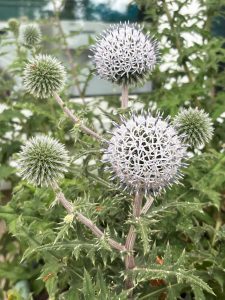
Echinops are globe thistles that sit on tall hairy stems, with green leathery spiky leaves. If you look closely at the spiked ball, you realize it’s made up of many delicate interlocking, tiny star-shaped flowers, with a dark spike in their centre. They are quite exquisite.
There are many species of Echinops, over 100 and they have been popular in gardens for centuries. Apparently they are named after Echinos, which means hedgehog!
There are also loads of cultivars, available for sale, mainly variations in white, silver and blue colours, like the Eryngiums. I think the one I have shown here is called Echinops bannaticus ‘Star Frost’.
There’s also a stunning blue ones of these, but I haven’t got a photo, so do have a look for those too. Echinops are also hugely attractive to all our pollinator friends too.
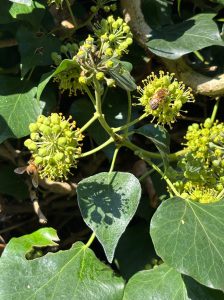
And on that note, I must mention something that’s very important environmentally and possibly because I’ve been looking closely at these globe shaped Echinops, I realized how similar in form they are to the flowers that are all over my humble ivy, which is bee central at the moment.
I didn’t realize until a few years ago that ivy actually flowers, now I know this, it seems silly to not think it would. However it is something that wildlife experts have been trying to educate us about, it’s a super important food source, both pollen and nectar for all types of insects, not just our busy bees in the autumn, when other sources may be drying up.
Add to this the fact that these flowers produce little black berries later in the year that are valuable food for blackbirds and others, and it’s also home to the numerous creatures which seek shelter in the ivy throughout the year.
So maybe consider pruning much later on after the berries have been eaten, please?