UP THE GARDEN PATH


Bluebells in their natural habitat, carpeting a woodland scene
Louise Tomlin takes a looks at the not-so-humble hyacinth and ponders its link to our wild bluebells
I’m hoping that by the time you read this that Spring will have well and truly sprung at last. For me it seems to have taken a long time to arrive this year. It’s still pretty nippy now at the time of writing this in early May and the rain has been relentless, sure we’ve had the occasional blast of warm sun, but it’s been fleeting and always followed by yet more rain.
At least these conditions seem to be favourable for the bluebells, which I noticed are out in strength. I usually try to treat myself to at least one visit to the woods when I spot that irresistible carpet of mauve beckoning in the distance. There’s something very soothing about meandering through the woods, allowing your mind to drift onto anything but your worries and taking in the unmistakable delicate scent of the flowers, it’s like a diluted and much more natural version of the fragrance you get from it’s cultivated cousins, the Hyacinth or hyathcinthus orientalis. They are one our most popular spring bulbs. I used to think they only came in standard white, blue and pink, but now I’ve noticed shades of cream, apricot, vivid purple and even wine red. Aside from their colours being a cheery sight in spring, their amazing fragrance sometimes seems to permeate through the whole garden. I usually plant some in my window boxes so that when I open the window on a spring day their scent fills the room.

cultivar colours I recently discovered
—
Apricot/Pink
Of course, the indoor hyacinth cultivars we enjoy will revert to bluebells or hyacinthoides non-scripta eventually, if they are left to their own devices. Now, I just said ‘of course’ as if we all know this.I feel like I’ve always known the bluebell is the ‘wild’ version of the shop-bought ones, but I don’t know how they happened to become so popular, so I thought I’d delve into how it came about.
It turns out that, like the trade in the popular tulip bulbs, the hyacinth’s history follows a parallel course owing much to the ease of transportation of its bulbs, which were traded from as early as the 1500s by merchants in Istanbul.
Historical sources verify they were established in Europe by the early 17th century, recognised as firm favourites in Holland and in France, they were prized for their scent and used in perfumery. Cultivation to develop a double-flowered version started as early as 1612, the earlier versions would have been reminiscent of the more delicate common bluebell and would have had only a few flowers. By 1680 in Holland, double-flowered Hyacinths had become the norm, and it’s this form that is the highly decorative and fragrant favourite we love to this day.

Back to the bluebells and a few interesting facts about them; they are also known by other names in the UK like; fairy bell, wood bell, bell bottle and in Scotland as the harebell. They are a protected species under the Wildlife and Countryside Act 1981, it’s illegal to pick, uproot or destroy them. There’s been much talk in recent decades about our native bluebells being threatened by the invasion of Hyacinthoides hispanica or the Spanish bluebell. I don’t know how serious the threat is, whether it’s as bad as our red squirrels being in danger of dying out due to them being booted out by the grey interlopers, but I have seen loads of Spanish ones around and I’m happy to report masses of our natives too.
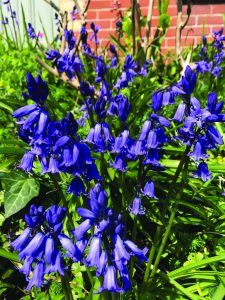
with tell tale longer flowers
Can you tell the difference between them? Below are some handy identifiers if you’re interested:
The native bluebell has narrow leaves with flowers on only one side of the stem, which tends to droop when they are mature. The flowers are deep blue, slim tubes with the ends curling back, inside the pollen is a pale cream colour and they have that delicate, sweet scent I mentioned earlier.
Spanish bluebells have much wider leaves sometimes up to 3cm. The flowers are conical in shape and more open than the native, and they grow out all around the stem. They can be pale blue, pink or white, which occurs when the blue pigment is absent, so technically they become albino. Perhaps this is one of the reasons they are a threat, as they can hybridize causing whites in our wild bluebells. The stem is fatter and upright instead of droopy and the pollen inside is pale green, having no scent.