Up the Garden Path

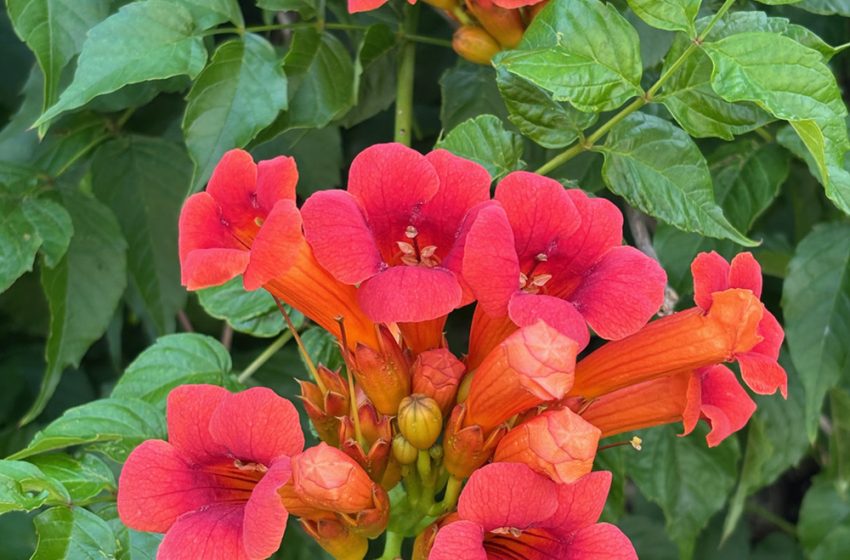
Louise does a mini-round-up of stand-out, sun-loving plants that have got her attention.
This time last year, I remember writing about one of the hottest, driest summers we’d experienced in many years. As a response to this I was looking at what plants would thrive in these much drier conditions. Now, it feels almost old hat, to be mentioning heat waves, as we’ve had even hotter, drier conditions this year, and it seems we’re learning to adjust, maybe?
So, I’m not going to talk about that side to our changing climate, instead I’m going to mention something that I’ve been wondering about, that might be happening as a result of the changing conditions. It’s a bit tricky to explain, but I’m wondering if the reason I’m suddenly noticing certain plants, like the ones I’ve chosen to feature in this article, is because all of a sudden they are bigger, better and more beautiful because they are now living in a climate in England that is more like the one they have originally come from.
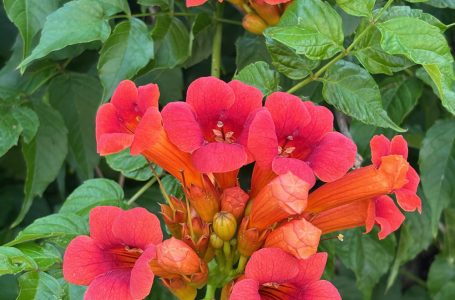
I suppose it may make more sense if I actually give you an example. I’ve walked in this area of a local park countless times and I’ve never before noticed this enormous and very lovely large flowering vine that’s growing over a wall. Goodness knows I go there often enough, but I’ve never spotted it before. Well, you know me – I did the usual, took lots of pics and did a bit of research.
Turns out it is a trumpet vine, Latin name Campsis radicans. This one was covered with masses of large trumpet shaped red-orange flowers. I’ve taken a close up photo of these, but the whole vine has spread many metres along a brick wall, it is huge and very impressive.
They are native to North America and are mostly hardy, but in very cold parts of the UK they need the protection of a wall, just like the one this is growing up. They are a self-clinging climber, readily climbing up walls in a similar way to ivy, apparently they can grow as high as 10m. This one is well on its way to taking over a large portion of the wall. What I’m wondering is, how come I haven’t spotted it before?
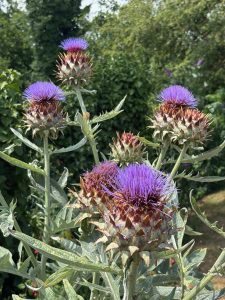
Anyway, less than a minute away from this was my next notable plant. I came across the most stunning example of Cardoons I’ve ever been lucky enough to see. I’ve always thought they’re a particularly beautiful plant, but these were absolute ‘stonkers’. They were so large, easily over the usual max height of 1.8m.
If you aren’t familiar with them, they are sort of giant thistles, also known as artichoke thistles (Cynara cardunculus). They are Mediterranean natives, growing wild in most areas, but they have also been cultivated as a vegetable, they’re related to the globe artichoke. The flowers are also a feast for our friends the bees and other pollinators. This large group of cardoons, were thriving in the hot, dry conditions.
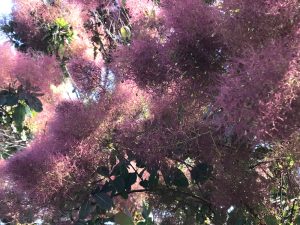
Another specimen that is going great guns in this scorching summer heat is the European Smoke Tree. As a garden bush or tree these haven’t really been on my radar much, I quite like some of the deep purple-maroon-ish ones, they can be striking, but there are several that I’ve noticed in the last couple of months that are stand out beauties.
Maybe they are just coming in to their own, but you can see why they are called smoke tree, the way the flowers catch the light in certain circumstances, it really is as if it’s smoking. I’ve tried to capture it with the photo here (probably not the greatest, but I’ve tried). These guys thrive in full sun and their foliage will be sparse if they don’t get enough sunshine, and they cope with dry conditions, once they are established.
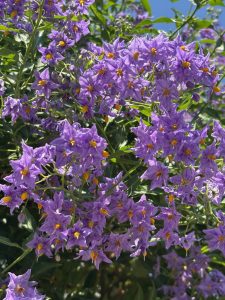
My final example in this mini-round-up of stand out sun-loving surprises is this fantastic nightshade. Now I’m very familiar with the wild plant, deadly nightshade. Every gardener should be because it’s poisonous.
I’m also well aware of the way the flowers look, like little five pointed stars with a yellow centre and how they seem to look very similar in the many members of this enormous family of some 2,500 and more plants, called Nightshade or Solanaceae which includes potatoes, tomatoes, peppers and all sorts of agricultural, medicinal and garden plants.
So when I got an eyeful of this particularly huge plant, I was stunned, firstly by the sensational colour. I don’t know if I recall seeing one of this vibrant purple before, but also by the sheer size, it is a very glamorous member of the nightshade family indeed.
So there we have it, I’ve singled out a few superb specimens that have definitely popped out of the woodwork for me, whether they’ve done so because they are loving the recent super-summer heat and sun, or for some reason I was just blind to them before, I hope they are of some interest to you my fellow plant lovers.