UP THE GARDEN PATH

Louise Tomlin takes a look at garden related topics. This time she’s offering us a blast of colourful blooms to cure the mid-winter blues.
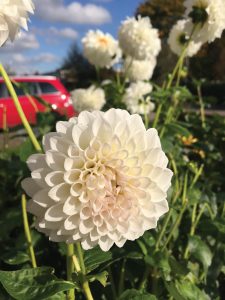
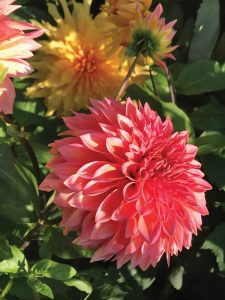
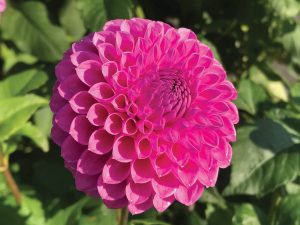
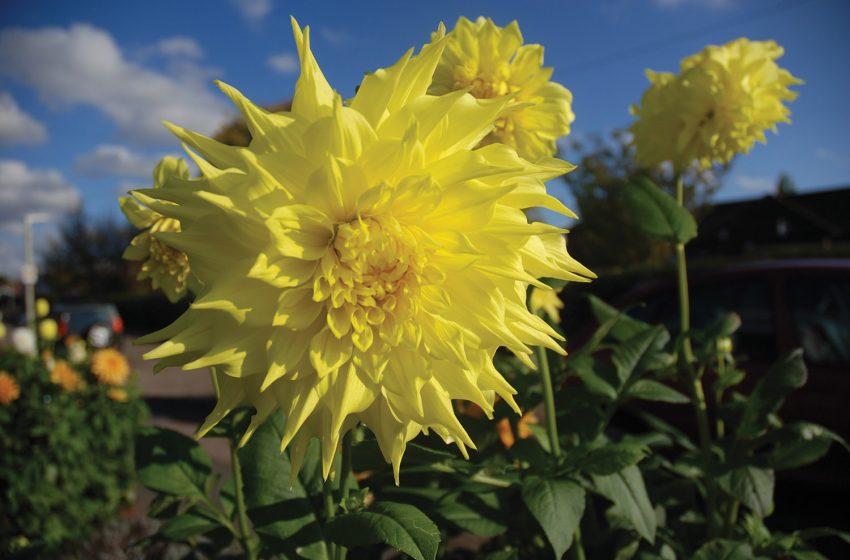
I was thinking about what to focus on for this December/January issue of F & L News, I guess there’s a lot of festive stuff going on for most people, like it or otherwise, it’spretty hard to escape from – but I’m not going to pile on the tinsel, glitter and Ho Ho Hos. Instead I’m thinking what we need is a big dose of the absolute opposite, something colourful, uplifting and beautiful, and the answer came to me when I was walking past a front garden in my area for the umpteenth time this autumn. It never fails to get my attention. Year after year, the owners of the garden put on an amazing show of Dahlias, it’s full of these luscious lovelies for anyone and everyone that passes by to get a full on flower fest, for free!
Having gained the appropriate permission from the owners of the garden to take photos and as I know next to nothing about Dahlias, I have set about rectifying the situation, so I can share a little of my newly found knowledge with you.
I know that the horticultural world can be as capricious as any specialist industry, being prone to fashion and trends. In the past I’ve heard people being a bit sniffy about these plants, beloved of amateur gardeners and allotment growers. Saying they are blousy and even too showy, how dare they? Fashion is fickle anyway, and in recent years there has been a groundswell of appreciation that has seen Dahlias return to favour. How anyone could be scathing about them beats me, they bloom at the end of the summer just when the winter blues can set in, giving us a tremendous fortifying blast of colour and form.
Dahlias are a native herbaceous perennial plant from Mexico, that arrived in Europe in the early 1800s and are members of the Asteracae family related to daisies, sunflowers, zinnias and chrysanthemums. These diverse hybrids are popular garden plants, with 42 species that vary in height from about 30cm to a staggering 2.4m. It’s worth noting that the taller ones will need stakes to support their fleshy stems from breaking in autumn winds. I didn’t know that they are mainly unscented and they attract pollinating insects with their strong colours instead of producing fragrance – there is a vast range of colours to choose from except for blue, apparently.
They grow from tuberous roots and in this country will flourish until the first frosts hit, at which point the tuber can be removed from the ground and stored in a cool, dry frost free place until it’s time to plant it out again when the warmer weather is back with us.
The flowers are obviously the main attraction with Dahlias, there are many different forms, colours and sizes, some as small as just 5cms and up to the whopping ‘dinner plate’ variety at about 30cms across. I found 14 different types of flower forms when researching these beauties. I won’t attempt to list them all here, as it soon becomes pretty mind boggling, spotting the difference between a Decorative Ball and Pompon is possibly a skill of the true enthusiast.
However I will pick out a few that I photographed for the purposes of this article, to give you a taster and I will attempt to accurately identify them for you, with the help of one of the major Dahlias supplier’s website (hallsofheddon.com) – fingers crossead I haven’t messed up, apologies if I have!
Many thanks to Irene and Peter Price of Canterbury for being kind enough to let me loose with my camera amongst their prized and very lovely Dahlias.