TIMBER, COMPOSITE OR ALUMINIUM MAKING THE RIGHT LONG-TERM CHOICE FOR FENCING


TIMBER, COMPOSITE OR ALUMINIUM MAKING THE RIGHT LONG-TERM CHOICE FOR FENCING

Every year, thousands of garden fences across the UK are replaced long before they need to be.
In many cases, the reason is simple: cheap pressure-treated softwood. Chosen because it appears to offer the most affordable option, but in a climate defined by increasingly unpredictable weather, the real cost of a fence is rarely the price on the invoice. It is what that fence costs to maintain, repair and eventually replace.
For installers and specifiers, that distinction matters more than ever. Homeowners are asking harder questions about longevity, maintenance and value, making material choice one of the most important decisions in any boundary project.
Alongside traditional timber, WPC composite and aluminium are increasingly being specified for their ability to deliver lasting performance with far less maintenance.
Where Treated Timber and Concrete Fall Short
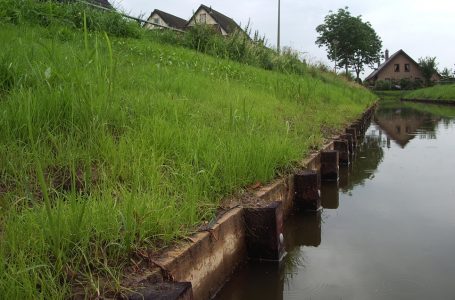
Pressure-treated softwood remains popular because it is familiar and inexpensive to buy. However, treatment only slows decay rather than preventing it.
Boards can absorb moisture through cut edges and warp and split as they dry unevenly, while regular, annual staining is needed to maintain their appearance and help protect against rot.
Post failure at ground level also remains a common cause of fence collapse.
Concrete avoids rot but brings its own weaknesses. Its porous structure can absorb water and, during freeze-thaw conditions, that moisture expands and can cause cracking and spalling. Once a concrete panel is damaged, replacement is often the only practical solution.
WPC Composite – Rot-Resistant with a Natural Finish
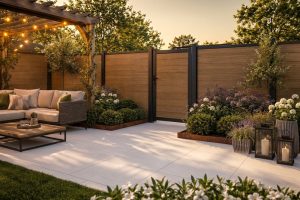
Composite fencing was developed to overcome many of timber’s weaknesses while retaining its warmth and character.
Modern second-generation Capstock WPC boards, such as those in F.H. Brundle’s Rinato™ range, feature a 360-degree polymer shield around a recycled core, helping protect against moisture ingress, UV fading and splitting at cut edges, with maintenance limited to an occasional wash-down.
Manufactured from 100% recycled materials using FSC® certified recycled wood fibre and polymer, the result is a fencing material that combines a natural timber appearance with significantly greater resistance to moisture, rot, splitting and everyday weathering.
For strength and long-term performance, particularly when it comes to wind loading and posts installed in the ground, Rinato™ fencing is paired with robust aluminium posts rather than WPC.
This provides the structural integrity and durability needed for a strong, long-lasting, maintenance-free fencing solution.
Aluminium – A Maintenance-Free, Long-Term Solution
Polyester powder-coated aluminium takes a different approach, removing organic material from the equation altogether.
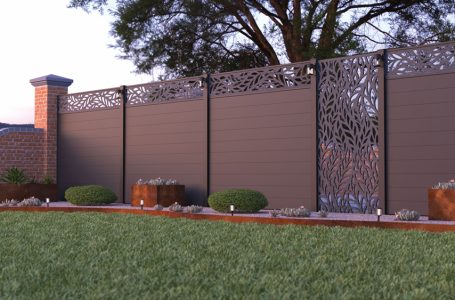
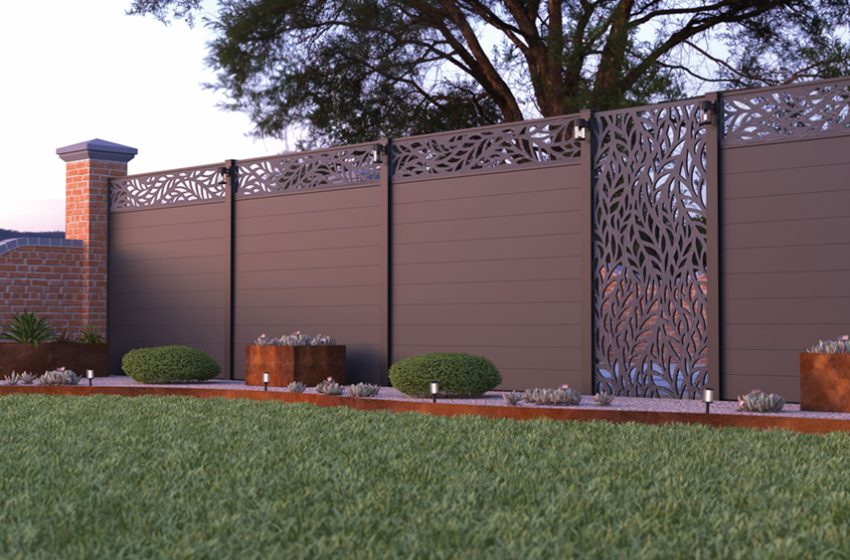
It will not rust, rot, corrode or warp, making it genuinely maintenance-free even in exposed or coastal locations. It is lightweight without sacrificing strength, and systems such as F.H. Brundle’s Marano® range use a single universal post that adapts to multiple board styles, simplifying both the planning and installation.
A wide choice of infill styles and finishes, from full privacy panels to gapped screens and laser-cut decorative options, gives specifiers considerably more design flexibility than traditional materials allow and, at end-of-life, aluminium is 100% recyclable.
Weighing Up the Options
The initial purchase price is only one part of the cost of a fence.
A lower-cost timber or concrete solution may appear attractive at the point of sale, but ongoing maintenance, repairs and eventual replacement can quickly change the equation.
For homeowners, composite and aluminium offer the opportunity to choose a fence based on how it will perform over time – decades, not years – rather than simply what it costs on day one.
Composite provides the familiar appearance of timber with greater resistance to the elements, while aluminium offers exceptional durability, little to no maintenance and extensive design flexibility.
For installers and specifiers, that makes composite and aluminium increasingly compelling alternatives to traditional fencing materials. They offer the combination of durability, low maintenance and contemporary design that today’s projects demand, helping deliver a boundary that continues to look good and perform well for years to come.
For more information, visit www.fhbrundle.co.uk